


Review by Natalie Fingerhut for The Seaboard Review of Books
I tend to only read non-fiction. There are so many real stories out there, who needs to read made-up tales?. There are a few exceptions, however, and one of them Is Toronto’s own, award-winning author of contemporary crime fiction, Howard Shrier.
I’ve read pretty much every word off of Shrier’s keyboard, including the highly entertaining Jonah Geller series and When It Was Cold — a collection of thrilling short stories. But his newest is truly a masterpiece of historical crime fiction that offers a moral commentary on justice and moral responsibility, both of which are deeply relevant to our current moment.
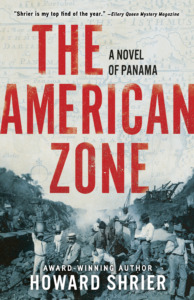
Set in 1906 during the construction of the Panama Canal, The American Zone sheds light on the little-known racial and political tensions that lay behind one of the world’s most iconic engineering feats.
Drawing on four years of historical research, Shrier centres his story on two men whose fates become intertwined in a racially segregated, Panama Canal work camp: Jack Adams, a white policeman who crawls out of the rubble of the San Francisco earthquake, receives gold pay, clean accommodations, and regular leave. Asa Hawkins, a 19-year-old Black cane-cutter from Barbados, is paid in silver, lives in overcrowded barracks, and endures backbreaking labour. The hierarchy is unfair, the racism disgraceful, the violence brutal.
When Asa kills a man in self-defence, Jack is ordered to track him down. What begins as a search for a murderer evolves into a reckoning. Increasingly disturbed by the injustices he witnesses, Jack begins to question the system he upholds. Navigating his very survival under constant threat, Asa must decide whether the man chasing him is capable of moral concern. Their fragile, evolving connection forms the emotional core of the novel.
Shrier develops this relationship with restraint and clarity. Jack experiences a gradual erosion of certainty in the American-run Canal building enterprise, shaped by the realities of systemic injustice and the ethical choices they impose on him. Dignified and perceptive, Asa emerges as a figure of remarkable moral strength. Together, they form a bond that feels unlikely, tentative, and deeply earned.
Throughout the book, characters mention Jack London’s “latest” book, [White Fang]. Shrier’s prose echoes London’s directness and economy, but the atmosphere—steeped in moral complexity and historical consequence—recalls Cormac McCarthy. The American Zone is a compact novel with the weight of a much larger canvas, exploring themes of power, labour, and race through personal experience rather than abstraction. The reader is in a bit of a quandary: the Panama Canal is remarkable, an economic miracle. But at what cost?
And the cost, as Shrier describes relentlessly, is great. The body count is high.
Shrier presents two sharply drawn female characters. Anne Currie, an American army nurse, works to reduce the appalling death toll in the camps. Sally Diamond, a journalist, seeks to expose the deep contradictions of the Canal project. Their perspectives offer insight into the Zone’s hyper-masculine culture and counterbalance the male-dominated world they inhabit.
President Theodore Roosevelt’s real-life 1906 visit to the Canal Zone becomes a pivotal moment. Shrier portrays him as a figure of genuine principle and boundless ambition—someone driven to see the Canal completed as a symbol of American ingenuity, yet failing to confront the suffering it entailed. Roosevelt’s presence intensifies the plot: Asa’s only hope lies in securing a pardon from a man who, for all his vision, may prove unwilling to look too closely.
The American Zone invites readers to consider how global infrastructure is built, who builds it, and who dies in the process. Shrier’s unflinching attention to injustice suggests a continuity between past and present. From the racialized labour of the Panama Canal to the exploitation of migrant workers during the 2022 World Cup in Qatar, the patterns persist.
In a story shaped by violence and structural inequality, Shrier identifies moments of grace, empathy, and mutual recognition. The American Zone is a beautifully crafted novel. Its power lies not in moral certainty, but in the insistence that the past is never past, and that the work of justice begins when we choose to see one another with clear eyes.
Natalie Fingerhut is a Senior Editor specializing in History at the University of Toronto Press.